

Avishkaar made one of the most theatrical entries of Shark Tank India Season 5 — founders Tarun Bhalla, Rajeev Gaba and Yogita Bhalla arrived in slow motion with a robotics toy, prompting jokes from Aman Gupta about how long they would take to reach the stage. The Sharks were genuinely intrigued by the product. They still did not invest.
- What is Avishkaar?
- The pitch: Rs 80 lakh for 1% equity
- The outcome: no deal
- Why edtech hardware struggles to raise
- The sales cycle is split in two
- Engagement decays
- “AI-based” invites scrutiny in 2026
- Hardware margins limit the upside
- What founders should take away
- Frequently Asked Questions
- Did Avishkaar get a deal on Shark Tank India Season 5?
- Who founded Avishkaar?
- What does Avishkaar make?
- What valuation did Avishkaar ask for?
- The bottom line
What is Avishkaar?
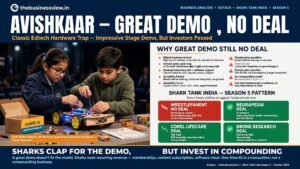
Avishkaar builds AI-based interactive toys designed as learning tools for children — robotics and coding education delivered through play rather than through a curriculum. The pitch positioned these as products that teach computational thinking to young minds without the child experiencing it as study.
The category has strong support behind it. India’s National Education Policy pushed coding and computational thinking into school curricula, robotics labs have proliferated in private schools, and urban parents are actively seeking screen-alternative educational products. Avishkaar sits squarely in that current.
The pitch: Rs 80 lakh for 1% equity
Avishkaar asked for ₹80 lakh for 1% equity, valuing the company at ₹80 crore.
Reports from the episode describe the discussion turning intense once the Sharks moved past the product demonstration and into the numbers, with visible disagreement among the panel about how to assess the business.
The outcome: no deal
Avishkaar left without an offer.
Note the contrast within Season 5 itself. In Episode 2, EMoMee — also an educational toy business — closed ₹2 crore for 4% at a ₹50 crore valuation. Avishkaar asked at ₹80 crore and got nothing. Same broad category, very different outcome.
| Brand | Category | Valuation ask | Outcome |
|---|---|---|---|
| EMoMee | Educational and emotional toys | ₹50 crore | Deal at ₹2 crore for 4% |
| Avishkaar | AI-based toys for kids | ₹80 crore | No deal |
Why edtech hardware struggles to raise
The sales cycle is split in two
Educational robotics companies typically sell to both schools and parents. School procurement is slow, relationship-driven, budget-constrained and seasonal. Direct-to-parent sales require heavy marketing. Running both motions at once is expensive and dilutes focus.
Engagement decays
The hardest metric in educational toys is not the first purchase — it is the fourth week. Robotics kits have a well-documented tendency to be enthusiastically used and then shelved. If retention data cannot answer that concern, investors assume the worst.
“AI-based” invites scrutiny in 2026
By Season 5, Sharks had heard the phrase enough times to interrogate it. Is the intelligence in the toy, or is it a marketing layer over conventional programmable hardware? Founders who cannot draw that line clearly lose credibility quickly.
Hardware margins limit the upside
Physical products carry manufacturing, inventory and after-sales costs that software does not. A ₹80 crore valuation on a hardware-led education business needs either exceptional volume or a recurring revenue layer to be defensible.
What founders should take away
- Delighting the room is not the same as convincing it. The Sharks enjoyed the demo and still passed. Product enthusiasm converts to investment only when the numbers follow.
- Your valuation is benchmarked against your own category. A comparable business had closed at ₹50 crore earlier in the same season. Asking 60% above that comparable required an argument the panel did not accept.
- Pick one buyer and win them. Split B2B and B2C motions rarely read as focus. They read as uncertainty about who the customer is.
Frequently Asked Questions
Did Avishkaar get a deal on Shark Tank India Season 5?
No. Avishkaar asked for ₹80 lakh for 1% equity in Episode 4 and did not receive an offer.
Who founded Avishkaar?
The pitch was made by Tarun Bhalla, Rajeev Gaba and Yogita Bhalla.
What does Avishkaar make?
AI-based interactive toys and robotics products designed as learning tools for children.
What valuation did Avishkaar ask for?
₹80 lakh for 1% equity implies an ₹80 crore valuation.
The bottom line
Avishkaar is in a category with policy support, parental demand and a genuinely engaging product. What it could not do in the Tank was justify a valuation 60% higher than a comparable brand that had already closed a deal that season. Being in the right market is the starting point of a pitch, not the argument.