

Sampark pitched a QR-based vehicle tag on Shark Tank India Season 5 — a simple, cheap product solving a problem almost every Indian vehicle owner has encountered. The Sharks passed, and the reason has nothing to do with whether the product works.
- What is Sampark?
- The pitch: Rs 1 crore for 2% equity
- The outcome: no deal
- Why a good product can still be a difficult business
- The purchase happens once, and then never again
- The price point limits everything
- There is no defensible technology
- It is a feature waiting to be absorbed
- What founders should take away
- Frequently Asked Questions
- Did Sampark get a deal on Shark Tank India Season 5?
- What does Sampark make?
- What valuation did Sampark ask for?
- Why did the Sharks reject Sampark?
- The bottom line
What is Sampark?
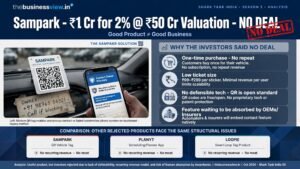
Sampark makes QR-based vehicle tags. The concept is elegantly simple: a sticker or tag on your vehicle carries a QR code. When someone needs to reach you — your car is blocking a driveway, your lights are on, there has been a minor incident, or your bike has been found after a theft — they scan the code and can contact you without ever seeing your phone number.
The privacy angle is the real product. Indians have long solved this by writing a mobile number on the windscreen, which exposes the number to anyone who walks past. A QR intermediary keeps the contact route open while keeping the number private.
The pitch: Rs 1 crore for 2% equity
Sampark asked for ₹1 crore for 2% equity, valuing the business at ₹50 crore.
The outcome: no deal
The Sharks did not invest. The reasons sit in the economics of the product rather than in its usefulness.
Why a good product can still be a difficult business
The purchase happens once, and then never again
A QR tag is bought a single time per vehicle. It does not wear out on a schedule, it does not get consumed, and there is no natural reason to return to the brand. Every rupee of revenue growth has to come from acquiring an entirely new customer. This is the same structural problem Planyt faced with smart plants earlier in the season, and the Sharks rejected that pitch too.
The price point limits everything
A sticker with a QR code has to be inexpensive, because customers instinctively price it against what it physically is. A low ticket size means the customer acquisition cost has to be extraordinarily low — which usually rules out paid marketing entirely and forces reliance on distribution partnerships or organic spread.
There is no defensible technology
QR codes are a free, open standard. The tag is printed. The backend is a simple contact-routing service. Nothing here prevents a competitor — or a large automotive accessory brand, or an insurer, or a vehicle manufacturer — from offering the identical thing tomorrow. Where the moat is absent, investors look for brand or distribution, and a young company has neither at scale.
It is a feature waiting to be absorbed
This is the sharpest risk. Vehicle manufacturers, insurance companies, FASTag providers and roadside assistance services could each bundle this capability into what they already sell. A standalone product that could plausibly become a checkbox inside a larger service is a difficult thing to fund at ₹50 crore.
What founders should take away
- Ask what the second purchase is. If there isn’t one, design a recurring layer — a subscription, a service, an ecosystem of related products — before you pitch.
- Solving a real problem is the entry ticket, not the argument. Season 5 rejected several genuinely useful products, including Planyt and Loopie, on exactly these grounds.
- Consider whether you are a product or a feature. If a larger player could add your functionality without much effort, your pitch has to explain why they will not — or why you will win anyway.
Frequently Asked Questions
Did Sampark get a deal on Shark Tank India Season 5?
No. Sampark asked for ₹1 crore for 2% equity and did not receive an offer.
What does Sampark make?
QR-based vehicle tags that let people contact a vehicle owner without exposing their phone number.
What valuation did Sampark ask for?
₹1 crore for 2% equity implies a ₹50 crore valuation.
Why did the Sharks reject Sampark?
The product is a one-time, low-value purchase with no technological moat and a real risk of being absorbed as a feature by vehicle manufacturers or insurers.
The bottom line
Sampark solves a problem that is real, common and irritating. That is not the same as being a company worth ₹50 crore. Shark Tank India Season 5 kept returning to the same test — does this compound, and can anyone else do it just as easily? A printed QR sticker struggles on both counts, however well it works.