

Gramiyaa brought a heritage-led proposition to Shark Tank India Season 5 — rural-inspired, traditional product offerings positioned for modern consumers — and asked for a ₹140 crore valuation. The Sharks found the concept genuinely interesting. They still did not invest.
- What is Gramiyaa?
- The pitch: Rs 1.4 crore for 1% equity
- The outcome: no deal
- Why heritage positioning is hard to defend commercially
- Authenticity is a claim, not a moat
- Traditional processes resist scale
- The category is fragmented and crowded
- A ₹140 crore valuation demands hard evidence
- What founders should take away
- Frequently Asked Questions
- Did Gramiyaa get a deal on Shark Tank India Season 5?
- What valuation did Gramiyaa ask for?
- What does Gramiyaa sell?
- Why did the Sharks reject Gramiyaa?
- The bottom line

What is Gramiyaa?
Gramiyaa is built around rural-inspired and traditional product offerings, aiming to bridge heritage concepts with contemporary consumer markets. It belongs to a category that has grown steadily in India — brands built on traditional processes, village-sourced ingredients or methods that predate industrial manufacturing.
The consumer logic behind this category is sound. Urban Indian buyers have shown consistent willingness to pay a premium for products framed as authentic, traditional or unprocessed. Cold-pressed oils, stone-ground flours, handmade goods and village-sourced foods have all found real markets.
The pitch: Rs 1.4 crore for 1% equity
Gramiyaa asked for ₹1.4 crore for 1% equity, valuing the business at ₹140 crore.
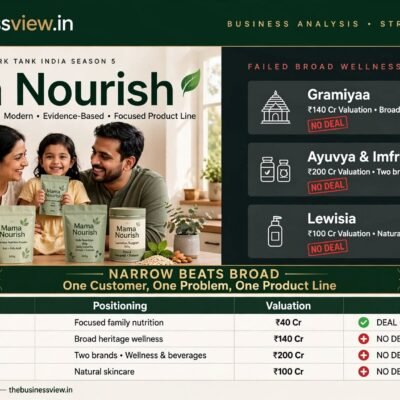
That places it among the highest consumer valuations of Season 5 — above True Diamond’s ₹108 crore and Croffle’s ₹100 crore, though below the ₹200 crore that Ayuvya and Imfresh sought.
The outcome: no deal
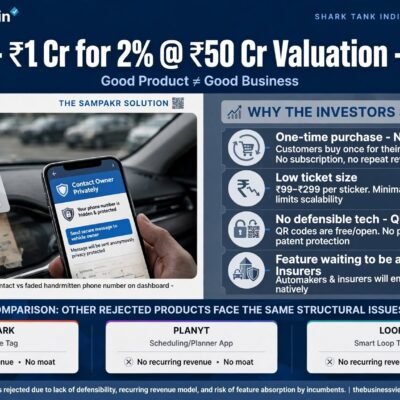
The Sharks raised three concerns: the valuation was too high, the competitive differentiation was unclear, and long-term scalability was in question. The feedback pointed toward a need for stronger brand positioning and clearer growth metrics.
By this stage of the season the pattern was well established. Every consumer brand asking above roughly ₹75 crore was rejected unless it had something structurally difficult to copy:
| Brand | Valuation asked | Outcome |
|---|---|---|
| Ayuvya & Imfresh | ₹200 crore | No deal |
| Gramiyaa | ₹140 crore | No deal |
| True Diamond | ₹108 crore | No deal |
| Lewisia Wellness | ₹100 crore | No deal |
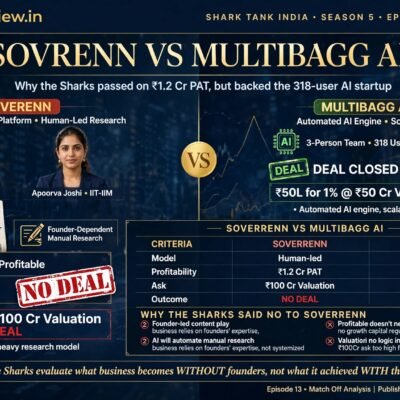
| Sovrenn | ₹100 crore | No deal |
Why heritage positioning is hard to defend commercially
Authenticity is a claim, not a moat
Any competitor can describe their product as traditional, village-sourced or made the old way. There is no certification that separates a genuine heritage brand from one that adopted the language last quarter. When the differentiator is a story, the differentiator can be retold by anyone.
Traditional processes resist scale
The methods that justify the premium — small-batch production, manual processes, local sourcing — are frequently the same methods that make growth difficult. Industrialising them undermines the claim. Not industrialising them caps the volume. This tension sits at the centre of every heritage brand’s business plan.
The category is fragmented and crowded
Regional traditional brands exist across India, many with decades of local trust. A national heritage brand competes with all of them simultaneously while carrying marketing and distribution costs they do not.
A ₹140 crore valuation demands hard evidence
At that price, investors need revenue, margin, repeat purchase and a credible expansion plan — not a positioning statement. Compare GOAT Life, which asked at ₹36 crore and brought a 40% repeat rate and 57% gross margins to the table. It closed at ₹25 crore with five times the capital.
What founders should take away
- Turn your story into a metric. “Rooted in tradition” becomes investable when it produces measurably higher repeat purchase or price realisation than competitors.
- Price for where you are, not for the brand you intend to become. A high ask in a category with weak defensibility is the fastest route to a rejection in this show’s format.
- Name the thing competitors cannot copy. Exclusive sourcing, a farmer network, a protected process or geographic indication — something concrete, not a description.
Frequently Asked Questions
Did Gramiyaa get a deal on Shark Tank India Season 5?
No. Gramiyaa asked for ₹1.4 crore for 1% equity and did not receive an offer.
What valuation did Gramiyaa ask for?
₹1.4 crore for 1% equity implies a ₹140 crore valuation.
What does Gramiyaa sell?
Rural-inspired and traditional product offerings aimed at modern consumer markets.
Why did the Sharks reject Gramiyaa?
They cited a high valuation, unclear competitive differentiation and questions about long-term scalability, and suggested the brand needed stronger positioning and clearer growth metrics.
The bottom line
Gramiyaa is in a category Indian consumers genuinely respond to. What Season 5 asked it to prove was why this particular brand, at ₹140 crore, is the one that captures that demand rather than any of the hundreds of others telling a similar story. Heritage explains why people buy. It does not, by itself, explain why they buy from you.