

True Diamond had the harder job in Shark Tank India Season 5’s first Match Off. Mumbai founders Darayus Mehta and Parin Shah pitched second, against a competitor who had already impressed the room — and asked for the highest valuation in the format. They left without a deal, but the pitch is worth studying for what it got right as much as what it got wrong.
- What is True Diamond?
- The pitch: Rs 1.08 crore for 1% equity
- Why the Match Off punished the higher ask
- Comparison strips away framing
- Going second is a disadvantage on price
- Offline stores are an asset and a cost
- “Content-first” needs numbers behind it
- What founders should take away
- Frequently Asked Questions
- Did True Diamond get a deal on Shark Tank India Season 5?
- Who founded True Diamond?
- Who won the Emori vs True Diamond Match Off?
- What valuation did True Diamond ask for?
- Where does True Diamond have stores?
- The bottom line
What is True Diamond?
True Diamond is a lab-grown diamond jewellery brand from Mumbai, run by Darayus Mehta and Parin Shah. Unlike its Match Off opponent Emori, True Diamond already operated offline stores across Delhi, Mumbai and Hyderabad — a genuine physical footprint in a category where most competitors are online-only.
The founders positioned themselves as content-first innovative ring specialists, explicitly differentiating from Emori on design creativity rather than on price or scale. They brought two signature pieces to demonstrate the point: the 3 Lovers Ring and Stairway To Heaven. Reports from the episode note that their candid, unpolished manner genuinely charmed the Sharks.
The pitch: Rs 1.08 crore for 1% equity
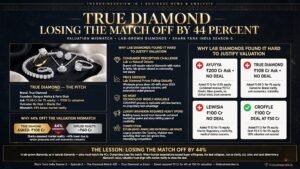
True Diamond asked for ₹1.08 crore for 1% equity, valuing the business at ₹108 crore.
That number is the crux of the whole episode. Here is the direct comparison the Sharks were forced to make:
| Emori | True Diamond | |
|---|---|---|
| Ask | ₹75 lakh for 1% | ₹1.08 crore for 1% |
| Implied valuation | ₹75 crore | ₹108 crore |
| Pitch order | First (won the toss) | Second |
| Outcome | ₹3 crore for 6% | No deal |
True Diamond asked for 44% more valuation than the brand it was directly competing against. In a solo pitch, that number would have been argued on its own merits. In a Match Off, it sat next to a cheaper alternative that the panel had already decided it liked.
Why the Match Off punished the higher ask
Comparison strips away framing
A founder pitching alone controls the narrative — you set the benchmarks, you choose the comparables. When a direct competitor has just presented, the Sharks already have a live reference point for what your category is worth. True Diamond’s ₹108 crore was not judged against the jewellery market. It was judged against ₹75 crore, spoken aloud ten minutes earlier.
Going second is a disadvantage on price
Emori won the toss and chose to pitch first, setting the anchor. The second brand then has to either come in lower — which looks like conceding — or come in higher and justify the premium immediately. True Diamond chose the second path and the justification did not land.
Offline stores are an asset and a cost
Physical retail in Delhi, Mumbai and Hyderabad is real proof of demand. It is also rent, staff, inventory and slower expansion. Investors weighing two similar brands will often prefer the one with the lighter cost structure and faster scaling path, unless the retail footprint is clearly driving superior economics.
“Content-first” needs numbers behind it
Marketing prowess is a legitimate differentiator — the brand reportedly used the platform to demonstrate exactly that. But content converts to investment only when it converts to customer acquisition cost, conversion rates and repeat purchase. Without those figures, it reads as a strength rather than a moat.
What founders should take away
- Know your competitor’s likely ask. In any comparative setting, your valuation is relative. Being 44% above a direct rival requires an argument that is prepared in advance, not improvised.
- Charm is not a substitute for differentiation. The founders were well liked. Likeability opens the conversation; economics closes it.
- A no-deal on national television still has value. True Diamond used the platform to showcase its marketing ability to millions of viewers. In a consumer category, that exposure has genuine commercial worth independent of the cheque.
Frequently Asked Questions
Did True Diamond get a deal on Shark Tank India Season 5?
No. True Diamond asked for ₹1.08 crore for 1% equity in the Episode 5 Match Off and did not receive an offer.
Who founded True Diamond?
Darayus Mehta and Parin Shah, based in Mumbai.
Who won the Emori vs True Diamond Match Off?
Emori, which closed ₹3 crore for 6% equity while True Diamond left without a deal.
What valuation did True Diamond ask for?
₹1.08 crore for 1% equity implies a ₹108 crore valuation.
Where does True Diamond have stores?
The brand operates offline stores in Delhi, Mumbai and Hyderabad.
The bottom line
True Diamond had physical retail, distinctive product design and founders the room warmed to. What it did not have was a reason for the Sharks to pay 44% more than the competitor standing beside it. The Match Off format made that gap impossible to talk around — and that is precisely what the format was designed to do.