

Nootie by Pet Point was the second brand in Shark Tank India Season 5’s pet food Match Off. It got a deal — but on terms that could hardly be more different from the one its competitor secured minutes earlier. For founders trying to understand how deal structure actually works, this pair of pitches is the best lesson of the season.
- What is Nootie by Pet Point?
- The pitch: Rs 1 crore for 1.2% equity
- The deal: Rs 1 crore for 4% plus a royalty
- What a royalty deal actually costs
- The investor gets their capital back before you scale
- It comes out of revenue, not profit
- It takes time to clear
- When it is still worth accepting
- What founders should take away
- Frequently Asked Questions
- Did Nootie by Pet Point get a deal on Shark Tank India Season 5?
- What valuation did Nootie by Pet Point get?
- Who won the Smylo vs Nootie Match Off?
- How does a royalty deal work on Shark Tank India?
- The bottom line
What is Nootie by Pet Point?
Nootie by Pet Point operates in pet food, competing in the same premium pet nutrition segment that has expanded rapidly across urban India. Pet ownership has risen sharply in Indian cities, and the shift from home-cooked scraps to formulated pet nutrition has created one of the most attractive repeat-purchase categories in consumer goods.
The pitch: Rs 1 crore for 1.2% equity
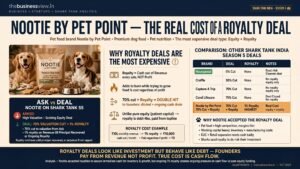
Nootie asked for ₹1 crore for 1.2% equity, valuing the business at approximately ₹83.3 crore — above the ₹68 crore its Match Off opponent Smylo had asked for.
The deal: Rs 1 crore for 4% plus a royalty
Nootie closed at ₹1 crore for 4% equity plus a 1% royalty until ₹1 crore is recouped. That equity component values the company at ₹25 crore.
| Smylo | Nootie by Pet Point | |
|---|---|---|
| Ask | ₹68 lakh for 1% | ₹1 crore for 1.2% |
| Valuation asked | ₹68 crore | ~₹83.3 crore |
| Deal | ₹75 lakh for 1% + 2% advisory | ₹1 crore for 4% + 1% royalty |
| Valuation received | ₹75 crore | ₹25 crore |
| Royalty | None | 1% until ₹1 crore recouped |
Same category. Same episode. One brand got its valuation raised to ₹75 crore with no royalty. The other took a 70% cut to ₹25 crore and a royalty on top.
What a royalty deal actually costs
Royalty structures are common on Shark Tank India and widely misunderstood by founders. The mechanics here: the investor takes 1% of revenue until ₹1 crore has been paid back, at which point the royalty stops and they retain the 4% equity.
The investor gets their capital back before you scale
A royalty is effectively principal protection. The Shark recovers the ₹1 crore from revenue regardless of whether the business ultimately succeeds, and keeps the equity upside afterwards. It converts part of a risky equity bet into something closer to a loan.
It comes out of revenue, not profit
This is the part founders underestimate. A 1% royalty on revenue in a business running 10% net margins is 10% of your profit. In pet food, where manufacturing, cold chain and distribution compress margins, that share can be materially higher.
It takes time to clear
At 1% of revenue, recouping ₹1 crore requires ₹100 crore in cumulative sales. For most brands at this stage, that is several years of the royalty running.
When it is still worth accepting
A royalty preserves equity. Nootie gave up 4% instead of the larger stake an investor might have demanded for unprotected capital. If the business compounds, that retained equity is worth far more than the royalty cost. Founders confident in their growth often take this trade deliberately.
What founders should take away
- Compare total cost, not headline valuation. Nootie’s deal looks like ₹1 crore for 4%. Its real cost includes a revenue share that runs for years.
- Asking higher than your rival is risky in a Match Off. Nootie asked at ₹83 crore against Smylo’s ₹68 crore and received the worse terms of the two.
- Model the royalty before you accept it. Run it against your projected revenue and margin. If it consumes a meaningful share of profit during your growth years, negotiate the cap or the percentage.
Frequently Asked Questions
Did Nootie by Pet Point get a deal on Shark Tank India Season 5?
Yes. Nootie closed ₹1 crore for 4% equity plus a 1% royalty until ₹1 crore is recouped.
What valuation did Nootie by Pet Point get?
₹25 crore on the equity component, against an ask that implied roughly ₹83.3 crore.
Who won the Smylo vs Nootie Match Off?
Both brands received offers, but Smylo secured materially better terms — a higher valuation with no royalty attached.
How does a royalty deal work on Shark Tank India?
The investor takes an agreed percentage of revenue until their capital is recovered, then stops collecting while retaining their equity stake.
The bottom line
Nootie by Pet Point walked away funded, which is a genuine outcome. But placed directly against Smylo, the difference in terms is stark. In the Match Off format, the founder who asked for less received more — and the one who asked for more paid for it twice, in equity and in revenue.