

In an episode that also featured a traditional sweets brand, Corel Lifecare pitched something no other business in Shark Tank India Season 5 came close to: nutrient food for fish farmers. It is one of the least glamorous propositions of the season, and it closed a deal.
- What is Corel Lifecare?
- The pitch: Rs 1.2 crore for 2% equity
- The deal: Rs 1.2 crore for 8% equity
- Why B2B agri-input businesses get funded
- The customer has a measurable ROI
- Repeat purchase is structural
- Distribution is the moat
- Policy support reduces risk
- Why the valuation still got cut 75%
- What founders should take away
- Frequently Asked Questions
- Did Corel Lifecare get a deal on Shark Tank India Season 5?
- What valuation did Corel Lifecare get?
- What does Corel Lifecare make?
- Which episode did Corel Lifecare appear in?
- The bottom line
What is Corel Lifecare?
Corel Lifecare makes nutrient feed for aquaculture — products that improve growth rates, survival and health in farmed fish. Its customer is not a consumer but a fish farmer running a commercial operation.
The sector behind it is much larger than most viewers would guess. India is among the world’s largest fish producers, and aquaculture is one of the fastest-growing segments of Indian agriculture, supported by government schemes aimed at raising productivity and farmer income. Feed is the single biggest input cost in a fish farming operation — typically the majority of it — which makes feed quality the primary lever on a farmer’s profitability.
The pitch: Rs 1.2 crore for 2% equity
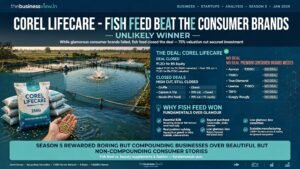
Corel Lifecare asked for ₹1.2 crore for 2% equity, valuing the business at ₹60 crore.
The deal: Rs 1.2 crore for 8% equity
The Sharks agreed to the full amount at a quarter of the price. The final deal was ₹1.2 crore for 8% equity, valuing the company at ₹15 crore.
| Ask | Deal | |
|---|---|---|
| Capital | ₹1.2 crore | ₹1.2 crore |
| Equity | 2% | 8% |
| Valuation | ₹60 crore | ₹15 crore |
That is a 75% valuation cut — the steepest of the season’s early episodes among pitches that still closed. But the founders received every rupee they asked for, in clean equity, with no royalty and no debt component. Set against Nootie’s royalty deal in the previous episode, that structure is materially better.
Why B2B agri-input businesses get funded
The customer has a measurable ROI
A fish farmer buying feed is making an investment decision, not an emotional one. If the product demonstrably improves yield or survival rates, the purchase justifies itself in numbers. There is no brand-building required, no customer acquisition cost driven by advertising, and no fashion risk.
Repeat purchase is structural
Feed is consumed continuously across the production cycle. Once a farmer adopts a product that works, switching introduces risk to a crop they cannot afford to lose. Retention in agri-inputs is among the strongest in any B2B category.
Distribution is the moat
Reaching fish farmers requires dealer networks, field demonstrations and technical support in farming districts. Building that takes years. Once built, it is very difficult for a competitor to dislodge — and it is exactly the kind of asset investors pay for.
Policy support reduces risk
Aquaculture receives active government backing in India through productivity and infrastructure schemes. Tailwinds of that kind shorten the path to scale.
Why the valuation still got cut 75%
B2B agri businesses grow steadily rather than explosively. Margins on feed are moderate, expansion is geographic and gradual, and there is no viral growth mechanic. A ₹60 crore valuation implies a trajectory that this category rarely delivers. ₹15 crore reflects a business the investors believe in at a price that matches how such businesses actually compound.
What founders should take away
- Unglamorous categories fund well. Season 5 rejected skincare, kidswear, sweets and smart plants while backing fish feed. Investors follow economics, not aesthetics.
- Clean structure is worth accepting a lower valuation for. Full amount, pure equity, no royalty — that is a better deal than a higher headline number with a revenue share attached.
- Know your category’s realistic growth rate. Asking at a valuation that implies consumer-tech growth from a steady B2B business invites a large correction.
Frequently Asked Questions
Did Corel Lifecare get a deal on Shark Tank India Season 5?
Yes. Corel Lifecare closed ₹1.2 crore for 8% equity, receiving the full amount it asked for.
What valuation did Corel Lifecare get?
₹15 crore, down from the ₹60 crore the founders asked for.
What does Corel Lifecare make?
Nutrient feed products for fish farmers, used in commercial aquaculture.
Which episode did Corel Lifecare appear in?
Episode 7 of Shark Tank India Season 5, alongside Pista Barfi.
The bottom line
Corel Lifecare took the largest valuation cut of any early-season deal and still walked out with the best kind of outcome — full funding, clean terms, and investors who understood the business. In the same episode, a sweets brand asking a tenth as much got nothing. The Sharks were not buying the story. They were buying the customer’s return on investment.