

TBFO pitched a women’s clothing brand on Shark Tank India Season 5 with a valuation that looked entirely sensible — ₹20 crore, backed by a willingness to part with 5% equity. The Sharks passed. In women’s fashion, that outcome is closer to the rule than the exception.
- What is TBFO?
- The pitch: Rs 1 crore for 5% equity
- The outcome: no deal
- Why women’s fashion is so hard to fund
- Inventory risk is unforgiving
- Returns destroy the unit economics
- Trends have no memory
- There is no barrier to entry
- What founders should take away
- Frequently Asked Questions
- Did TBFO get a deal on Shark Tank India Season 5?
- What does TBFO sell?
- What valuation did TBFO ask for?
- Did any apparel brand get a deal in Shark Tank India Season 5?
- The bottom line
What is TBFO?
TBFO operates in women’s clothing, one of the largest consumer categories in India and simultaneously one of the least investable at early stage.
The market size is not the issue. Indian women’s apparel runs into hundreds of thousands of crores across ethnic wear, western wear, fusion and occasion wear. The issue is that the category has attracted an extraordinary volume of entrants — from established retail chains to marketplace sellers to Instagram-native labels — and almost none of them build a durable advantage.
The pitch: Rs 1 crore for 5% equity
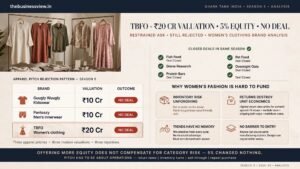
TBFO asked for ₹1 crore for 5% equity, implying a ₹20 crore valuation.
By Season 5 standards this was a restrained ask. The founders offered five times the equity that most consumer brands earlier in the season had put on the table, at a fifth of the valuation.
The outcome: no deal
It did not convert — continuing a pattern that ran through the entire season. Every apparel brand covered so far in Season 5 met the same fate:
| Brand | Category | Valuation asked | Outcome |
|---|---|---|---|
| Guugly Wuugly | Kidswear | ₹10 crore | No deal |
| Panteazy | Men’s innerwear | ₹10 crore | No deal |
| TBFO | Women’s clothing | ₹20 crore | No deal |
Three apparel pitches, three modest valuations, three rejections. Meanwhile fish feed, drone research, protein bars, pet food and overnight oats all closed deals in the same season.
Why women’s fashion is so hard to fund
Inventory risk is unforgiving
Fashion is a bet on taste placed months before the customer sees the product. Fabric is bought, designs are produced, and sizes are stocked ahead of demand. When a collection does not sell, the inventory does not simply wait — it loses value every season. Working capital in apparel is consumed at a rate that few other consumer categories match.
Returns destroy the unit economics
Online women’s apparel carries some of the highest return rates in Indian e-commerce, driven by fit and by the common habit of ordering multiple sizes. Every return costs shipping both ways, handling, quality checks and often a markdown. A brand can look profitable on gross margin and lose money on delivered margin.
Trends have no memory
A brand that reads one season correctly has no structural advantage in the next. Unlike food or personal care, where a customer settles into a product and repurchases, fashion requires you to win the customer’s attention afresh every cycle.
There is no barrier to entry
Anyone can source from the same manufacturing clusters, photograph a collection and sell it. Design is copied within weeks. Whatever moat exists lives entirely in brand strength, which takes years and considerable capital to establish.
What founders should take away
- Offering more equity does not compensate for category risk. TBFO put 5% on the table and it changed nothing, exactly as it did for Guugly Wuugly and Planyt.
- In fashion, the pitch has to be about operations. Return rates, inventory turns, sell-through percentage and repeat purchase are the numbers that decide the conversation. Design and aesthetic are assumed.
- Consider what makes you not-fashion. Brands that escape this trap usually do so by anchoring to something more durable — a fit system, a fabric technology, a specific underserved body type or occasion — rather than to a seasonal aesthetic.
Frequently Asked Questions
Did TBFO get a deal on Shark Tank India Season 5?
No. TBFO asked for ₹1 crore for 5% equity and did not receive an offer.
What does TBFO sell?
TBFO is a women’s clothing brand.
What valuation did TBFO ask for?
₹1 crore for 5% equity implies a ₹20 crore valuation.
Did any apparel brand get a deal in Shark Tank India Season 5?
The clothing pitches covered in this series — Guugly Wuugly, Panteazy and TBFO — were all rejected, despite each asking at conservative valuations.
The bottom line
TBFO priced itself reasonably and offered meaningful equity, and it still could not get past the structural objections that make Indian apparel a difficult investment. For fashion founders, the lesson from Season 5 is direct: the Sharks are not asking whether your clothes are good. They are asking what stops the next hundred brands from doing exactly what you do.